
OBC
NEW RELEASES
Available now on digital platforms

VOL. I
The Barcelona Symphony Orchestra (OBC) and Music Director Ludovic Morlot – renowned specialist in French repertoire with four Grammy awards – release the complete orchestral works of Maurice Ravel in six CDs between April 2024 and December 2026. The first volume of the collection, recorded at the Pau Casals Hall of L’Auditori with Mike George and Stephen Rinker – producer and sound engineer of the BBC and Chandos label – includes three iconic works by the composer from Ciboure (French Basque Country).
Ludovic Morlot’s precision and control of orchestral color give these recordings great transparency, with meticulously balanced sound and expressiveness that showcase the OBC’s poetic capacity. Additionally, the collection features the editorial revision of the complete orchestral works of the French composer: the Ravel Edition, a project that brings together artists such as Bertrand Chamayou, Renaud Capuçon, François-Xavier Roth, Ludovic Morlot, George Benjamin, Kirill Karabits, or Cristian Măcelaru, among others.






U
Jordi Savall described Bernat Vivancos’ music as a new musical Renaissance: “His extraordinary talent and his profound spirituality are placed at the service of a process that is the invention of a new language which, in spite of its complexity and modernity, is capable of transmitting to us pure beauty and emotion.”
In U, commissioned in 2021 by the OBC and recorded in 3D format in 2022 under the direction of Maestro Ludovic Morlot, the big orchestra is rearranged into three different groups according to tuning. Thus, as in a sea of rich and vibrant colours, waves of richly microtonal textures collide. In this piece, Vivancos represents a longing, the desire to get closer, to make our own that light in the abyss of darkness, that glimmer of hope that we only intuit, an oasis in the desert, and which we glimpse in the middle of thousands of difficulties. The delicate, incredibly fine melody that shines pure, like a crack in a wide wall of sound.
HOMENAJE A LIGETI
No lover of the arts (in their plural representations) can hide the somewhat presumptuous pleasure of feeling – seemingly for oneself – a connection with a creator’s oeuvre whose work is fodder and nourishment for the praise and admiration of a select few. Let this preamble be a tribute to the person and – clearly even more so – the catalogue of composer Sofía Martínez (1965), a catalogue that is quite reduced, staggered over time and savoured. Nor is her presence on the Internet significantly prolific. It is plausible that music like hers requires neither an excessive song and dance nor digital proliferation. In her biographical note, published on her concise and monastic web page, we read: «Her investigations lead her to explore quarter tones and deliciously slow glissandos. Like in quantum physics, the uncertainty principle, where the traditional reference points for both notes and time are lost. It is not about finding the precision of the note, but its most secret part, moving towards an inner path.»
Orchestral Works
Half a century ago, the American Gloria Coates showcased the expressive power of the glissando, brandished as a more than self-sufficient feature with which to create sonorous spaces that our ears could be well comfortable with. Several decades after those first monothematic experiences, in 2021 composer Núria Giménez Comas (1980) presents a work like Nostalgia of light, Yearning for…, an orchestral score in which – albeit with a different method and a different conduct – that characteristic sliding from one note to another, in rapid succession, once again takes centre stage. The glissando is a purely contemporary gesture, one could even say a calling card, a universe in and of itself used in highly diverse environments by the most outstanding creators of the second half of the twentieth century. On this occasion, the value is how our composer from Girona has integrated it into the context of a “luminous” orchestration, in her own words. To be more graphic, and even at the risk of crossing the line into the excessively poetic, we could add ‘Mediterranean’.

CATALOGUE
Available on digital platforms
ORCHESTRAL FOLKSONGS
Robert Gerhard’s love for Catalonia, for its cultural traditions and for its popular music nourished his creativity throughout most of his artistic life. Where this was most evident was in his “Catalan Folksongs”.
To commemorate the centenary since the birth of his teacher Felip Pedrell, Gerhard composed “Cancionero de Pedrell”, the ‘bouquet of wildflowers for Pedrell’s grave’, as he described it.
Soprano Núria Rial and Catalan conductor Francesc Prat join the OBC to offer a conscientious version of these traditional songs for orchestra.
LA DONNA
Cassandra Miller’s music has been described by Alex Ross as ‘immensely beautiful and immensely haunting’, and by The Observer as ‘generous, engaging and unlike any other music’. Her Duet for Cello and Orchestra was hailed by The Guardian as one of the ‘finest classical music works of the 21st century’.
Cassandra Miller is a Canadian composer based in London. Her written works explore transcription as a creative process and automatic singing as compositional material. La Donna was commissioned by L’Auditori for the OBC.
IN LUCE PRAESENTI
‘There is little music as delicate and evocative as that of Miquel Oliu. Mastery of materials, extraordinarily fluid form, penetrating poetic images, profound silences, and exceptional communicative ability: a brilliant composer.’ This is how composer Ramon Humet presents the music of Miquel Oliu.
Miquel Oliu won the prestigious Reina Sofia Prize for Music Composition in 2015. In Luce Praesenti, commissioned by L’Auditori and premiered by the OBC and Juanjo Mena in 2021, evidences a sound universe full of detail and subtlety. With an orchestration full of French reminiscences, the work sketches a clear and clean structure, without artifice or elements that seek contradictions in its formal development.

BMB
NEW RELEASES
Available now on digital platforms

OBRAS PARA BANDA SINFÓNICA
Carles Suriñach (Barcelona, 1915) emigrated to the United States in the 1950s, where he developed an important career as a ballet composer with the prestigious choreographer Martha Graham, in addition to composing symphonic works, concerts and chamber music. This recording includes some of his most notable works for symphonic band.
HYMN AT TWILIGHT
The BMB commissioned Hymn at Twilight (2019) from English master Philip Sparke (London, 1951). With this piece by master Sparke, one of the most performed composers in band programmes round the world, we find ourselves before a score with raw intimacy, in which the band’s palette of colours is developed in an extraordinary way to create atmospheres full of light and sound sensitivity.
URBAN LANDSCAPES
The BMB premiered Symphony No. 3 ‘Urban Landscapes’ Op. 55 (2020) during the 2020-2021 season. The work of Swiss conductor and composer Franco Cesarini (Bellinzona, 1961) stands out for its great stylistic versatility, with one large defining trait: creative craftsmanship based on primary elements that serve as a nexus throughout its structures. In his Symphony No. 3, subtitled ‘Urban Landscapes¡, he pays homage to the Windy City, Chicago, mixing styles typical of 20th century American music (Gershwin, Copland, Reed) at the service of his quest for thematic unity that so characterises him.
VÉRTIGO Y LLAMA
Vertigo y Llama (2018) could be defined as a sound proposal based on the deconstruction of different pre-existing sound materials to give them a new use. Its author, José Miguel Fayos-Jordán (Chella, 1980), is an emerging persona in today’s musical creation, his constant search in this area has led him to create several musical pieces such as the one we present today, in which the verses of Mexican Octavio Paz are mixed with quotes from the Llibre Vermell de Montserrat (Red Book of Montserrat), producing a deconstruction of harmonic spectra throughout the composition.
L’AUDITORI LABEL
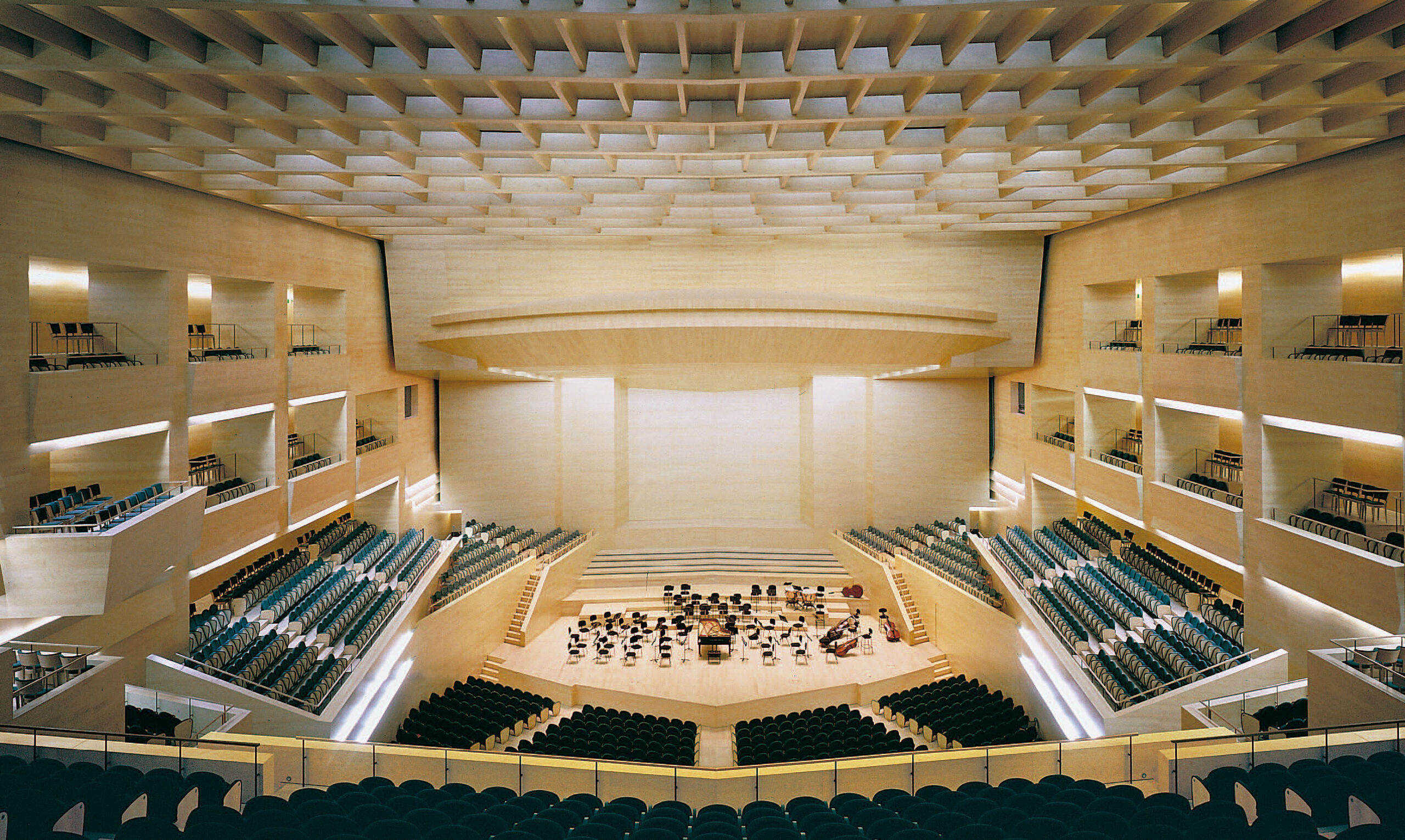
L’Auditori label is a comprehensive digital platform at the service of documenting and disseminating our sound heritage, as well as a tool for creation for today’s composers. Incorporating new recording technologies and new distribution formats, L’Auditori’s label believes in the potential of sound recordings for an essential listening ritual, and wants to be a loudspeaker for musical tradition and modernity in the digital environment.
A recording project aimed at the publication of monographic albums on digital format, accessible free of charge and complemented by specific documentation of images and texts available on L’Auditori’s website. A virtual space for listening to our musical history.
RELEASES 2023-2024
During the 2023-2024 season, L’Auditori’s label consolidates the recording projects of the OBC Barcelona Symphony Orchestra and the BMB Barcelona Symphonic Band, progressively incorporating their catalogue of recordings on commercial digital platforms and structuring a plan for symphonic releases with an international distribution and promotion strategy adapted to this transformative moment today’s music industry is facing.
The catalogue of the L’Auditori label contains three main editorial lines: Catalan music, female composers, and the complete symphonic works of Maurice Ravel with the OBC – the star recording project of our orchestra in the hands of maestro Ludovic Morlot, a specialist on Maurice Ravel and winner of 4 Grammy Awards for his recording career. The complete Ravel is linked to an editorial review of the French composer’s complete symphonic works: the Ravel Edition, a project that features artists of the stature of Bertrand Chamayou, Renaud Capuçon, François-Xavier Roth, Ludovic Morlot, George Benjamin, Kirill Karabits, and Cristian Măcelaru, among others. This collection of OBC albums will be released on six CDs between March 2024 and December 2026.
The OBC will also commercially release albums by Catalan composers such as Robert Gerhard, Núria Giménez Comas, Hèctor Parra, Bernat Vivancos, and Miquel Oliu. And it will open an editorial line of female composers with whom the orchestra will have close artistic relations during the next two seasons, such as Canadian Cassandra Miller, American Gabriella Smith, and Catalan Raquel García Tomás.
The BMB, under the guidance of maestro José R. Pascual Vilaplana, will release several monographic albums on digital platforms, now only available at L’Auditori Play: recordings by composers such as Miguel Asins Arbó, Carles Suriñach, Philip Sparke, Franco Cesarini and Fayos-Jordán, to which new recordings by Xavier Pagès-Corella and Amando Blanquer Ponsoda will be added. A record collection that combines significant works from the band’s repertoire with the immense heritage works that the Band has been creating since its inception.
Finally, L’Auditori label promotes two recordings by the Ensemble O Vos Omnes, which will culminate its residency at L’Auditori with the release of folkloric recordings created under the direction of Xavier Pastrana: the choral music of Manuel Oltra and the lamentations of Bernat Icart and Joan Pau Pujol.
SUPPORTED BY